Showing posts with label Facebook – TechCrunch. Show all posts

Friday, January 11, 2019

Research finds heavy Facebook users make impaired decisions like drug addicts

Researchers at Michigan State University are exploring the idea that there’s more to “social media addiction” than casual joking about being too online might suggest. Their paper, titled “Excessive social media users demonstrate impaired decision making in the Iowa Gambling Task” (Meshi, Elizarova, Bender, & Verdejo-Garcia) and published in the Journal of Behavioral Addictions, indicates that people who use social media sites heavily actually display some of the behavioral hallmarks of someone addicted to cocaine or heroin.

The study asked 71 participants to first rate their own Facebook usage with a measure known as the Bergen Facebook Addiction Scale. The study subjects then went on to complete something called the Iowa Gambling Task (IGT), a classic research tool that evaluates impaired decision making. The IGT presents participants with four virtual decks of cards associated with rewards or punishments and asks them to choose cards from the decks to maximize their virtual winnings. As the study explains, “Participants are also informed that some decks are better than others and that if they want to do well, they should avoid the bad decks and choose cards from the good decks.”

What the researchers found was telling. Study participants who self-reported as excessive Facebook users actually performed worse than their peers on the IGT, frequenting the two “bad” decks that offer immediate gains but ultimate result in losses. That difference in behavior was statistically significant in the later portion of the IGT, when a participant has had ample time to observe the deck’s patterns and knows which decks present the greatest risk.

The IGT has been used to study everything from patients with frontal lobe brain injuries to heroin addicts, but using it as a measure to examine social media addicts is novel. Along with deeper, structural research, it’s clear that researchers can apply much of the existing methodological framework for learning about substance addiction to social media users.

The study is narrow, but interesting and offers a few paths for follow-up research. As the researchers recognize, in an ideal study the researchers could actually observe participants’ social media usage and sort them into categories of high or low social media usage based on behavior rather than a survey they fill out.

Future research could also delve more deeply into excessive users across different social networks. The study only looked at Facebook use, “because it is currently the most widely used [social network] around the world” but one could expect to see similar results with the billion-plus monthly Instagram and potentially the substantially smaller portion of people on Twitter.

Ultimately, we know that social media is shifting human behavior and potentially its neurological underpinnings, we just don’t know the extent of it — yet. Due to the methodical nature of behavioral research and the often extremely protracted process of publishing it, we likely won’t know the results of studies conducted now for years to come. Still, as this study proves, there are researchers at work examining how social media is impacting our brains and our behavior, we just might not be able to see the big picture for some time.


from Facebook – TechCrunch https://tcrn.ch/2QDOLvE
via IFTTT
Thursday, January 10, 2019

Instagram now lets you regram your posts to multiple accounts

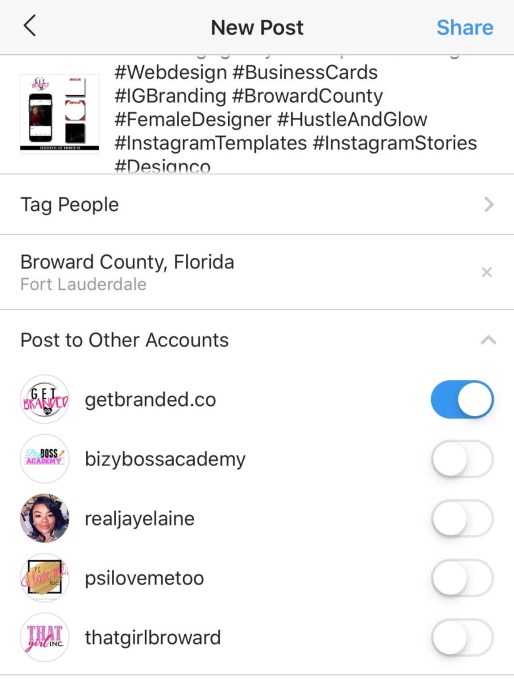
Instagram is swaying the balance towards simplicity but away from originality. It’s adding the ability to publish feed posts to different accounts you control at the same time by toggling them on within the composer screen. An Instagram spokesperson confirms this option is becoming available to all iOS users, telling TechCrunch “We are rolling out this feature to provide a better experience for people who often post to multiple accounts.”

This “self regram” could make it easier for businesses, influencers, and regular folks with Instas and Finstas to publish the same meme, promotional image, or other content across their profiles simultaneously instead of having to post on one at a time. But it could also make Instagram’s feed a bit more cookie-cutter, with different audiences of different accounts seeing the same shots and captions. The desire to keep the feed original and personal has been a driving force behind Instagram refusing to add a native regram feature for sharing other people’s feed posts to your audience.

Instagram gives all iOS users the ability to publish a post to several of their own accounts at once

Recontextualizing posts uniquely for different accounts or networks is some of the most common social media guru advice. A personal account might want to publish with a more informal, colloquial and intimate style. A business account might be better off acting generally accessible and adding a call to action. A Finsta, or fake Instagram account people keep on the side for posting more raw content, is free to get a little crazy. An identical one-size-fits-all post might actually be one-size-fits-none. That’s why we’d suggest only using this feature if your different accounts have similar themes and fan bases.

TechCrunch first discovered the feature thanks to a tip from SocialThings founder Zachary Shakked, who says “it could save a tiny bit of time”. Other users including Jay Elaine’s Get Branded also showed off the new feature, as seen above. Once users select a photo or video to post, the Instagram for iOS composer screen for adding captions and tags now includes toggle switches for syndicating the post to your other accounts to which you’re logged in. We’ve asked whether the feature will come to Android (I’d assume so in the future), and Stories (anyone’s guess), but Instagram hasn’t responded. You still can’t regram posts by other people, or your own after you publish.

Instagram is now testing a much more prominent way to import photos from Google Photos on Android

As Instagram grows beyond the 1 billion monthly user mark, it’s working to eliminate friction from content creation wherever it can. Instagram recently began testing a much more prominent shortcut of importing photos from Google Photos on Android. First spotted by mobile researcher and all-star TechCrunch tipster Jane Manchun Wong, the Photos shortcut is now right on the image selection screen for some users instead of being buried within the Other folder of your albums. An Instagram spokesperson confirmed that “We are only testing this on Android. You have been able to share to feed from Google photos on Android before but the ability to do so was hidden behind a couple of different steps so we’re up-leveling that ability to make it easier.”

Simplifying publishing sounds obviously better, but it could also dilute the quality of Instagram. Luckily, the feed’s algorithm can simply demote generic content that doesn’t resonate with people. But if the feed becomes full of stale cross-posted promotional spam, it could send younger users fleeing towards the next generation of social apps trying to spice it up.


from Facebook – TechCrunch https://tcrn.ch/2SMR5SE
via IFTTT

Daily Crunch: Well Facebook, you did it again

The Daily Crunch is TechCrunch’s roundup of our biggest and most important stories. If you’d like to get this delivered to your inbox every day at around 9am Pacific, you can subscribe here:

1. Facebook is the new crapware 

Well Facebook, you did it again. Fresh off its latest privacy scandal, the troubled social media giant has inked a deal with Android to pre-install its app on an undisclosed number of phones and make the software permanent. This means you won’t be able to delete Facebook from those phones. Thanks, Facebook.

2. The world’s first foldable phone is real 

Chinese company Royole has beaten Samsung to the market and has been showing off a foldable phone/tablet this week at CES. While it’s not the most fluid experience, the device definitely works at adapting to your needs.

3. CES revokes award from female-founded sex tech company
Outcries of a double-standard are pouring out of CES after the Consumer Tech Association revoked an award from a company geared toward women’s sexual health.

4. Everything Google announced at CES 2019 

Google went all in on the Assistant this year at CES. The company boasted that the voice-enabled AI will make its way onto a billion devices by the end of the month — up from 400 million last year. But what’s most exciting is the expanded capabilities of Google’s Assistant. Soon you’ll be able to check into flights and translate conversations on the fly with a simple “Hey Google.”

5. Rebranding WeWork won’t work 

The company formerly known as WeWork has rebranded to the We Company, but its new strategy has the potential to plunge the company further into debt.

6. Despite promises to stop, US cell carriers are still selling your real-time phone location data

Last year a little-known company called LocationSmart came under fire after leaking location data from AT&T, Verizon, T-Mobile and Sprint users to shady customers. LocationSmart quickly buckled under public scrutiny and promised to stop selling user data, but few focused on another big player in the location tracking business: Zumigo.

7. The best and worst of CES 2019 

From monster displays to VR in cars, we’re breaking down the good, the bad and the ugly from CES 2019.


from Facebook – TechCrunch https://tcrn.ch/2C9mYh9
via IFTTT

Wednesday, January 9, 2019

Cambridge Analytica’s parent pleads guilty to breaking UK data law

Cambridge Analytica’s parent company, SCL Elections, has been fined £15,000 in a UK court after pleading guilty to failing to comply with an enforcement notice issued by the national data protection watchdog, the Guardian reports.

While the fine itself is a small and rather symbolic one, given the political data analytics firm went into administration last year, the implications of the prosecution are more sizeable.

Last year the Information Commissioner’s Office ordered SCL to hand over all the data it holds on U.S. academic, professor David Carroll, within 30 days. After the company failed to do so it was taken to court by the ICO.

Prior to Cambridge Analytica gaining infamy for massively misusing Facebook user data, the company, which was used by the Trump campaign, claimed to have up to 7,000 data points on the entire U.S. electorate — circa 240M people.

So Carroll’s attempt to understand exactly what data the company had on him, and how the information was processed to create a voter profile of it, has much wider relevance.

Under EU law, citizens can file a Subject Access Request (SAR) to obtain personal data held on them. So Carroll, a U.S. citizen, decided to bring a test case by requesting his data even though he is not a UK citizen — having learnt Cambridge Analytica had processed his personal data in the U.K.

He lodged his original SAR in January 2017 after becoming suspicious about the company’s claim to have built profiles of every U.S. voter.

Cambridge Analytica responded to the SAR in March 2017 but only sent partial data. So Carroll complained to the ICO which backed his request — issuing an enforcement notice on SCL Elections in May 2018, days after the (now) scandal-hit company announced it was shutting down.

The company pulled the plug on its business in the wake of the Facebook data misuse scandal, when it emerged SCL had paid an academic with developer access to Facebook’s platform to harvest data on millions of users without proper consents in a bid to create psychological profiles of U.S. voters for election campaign purposes.

The story snowballed into a global scandal for Facebook and triggered a major (and still ongoing) investigation by the ICO into how online data is used for political campaigning.

It also led the ICO to hit Facebook with a £500,000 fine last year (the maximum possible under the relevant UK data protection law). Although the company is appealing.

The SCL prosecution is an important one, cementing the fact that anyone who requests their personal information from a U.K.-based company or organisation is legally entitled to have that request answered, in full, under national data protection law — regardless of whether they’re a British citizen or not.

Commenting in a statement, information commissioner Elizabeth Denham said: “This prosecution, the first against Cambridge Analytica, is a warning that there are consequences for ignoring the law. Wherever you live in the world, if your data is being processed by a UK company, UK data protection laws apply.

“Organisations that handle personal data must respect people’s legal privacy rights. Where that does not happen and companies ignore ICO enforcement notices, we will take action.”

The Daily Beast reports that at today’s hearing at Hendon magistrates the court was told that the administrators of Cambridge Analytica and its related companies had now provided relevant passwords to the ICO.

Cambridge Analytica had previously failed to supply these passwords.

This means the regulator should be able to gain access to more of the data it seized when it raided the company’s London offices in March last year. So it’s at least possible Carroll’s SAR might eventually be fulfilled that way, i.e. by the regulatory sifting through the circa 700TB of data it seized.

However Carroll told TechCrunch he’s hoping for a faster route to get to the truth of exactly what the company did with his data, telling us there’s still “a March court event that could yield our end goal: Disclosure”.

“Why would they rather plead guilty to a criminal offense instead of complying with disclosure required by UK DPA ‘98. What are they hiding? Why has it come to this?” he added.

“Testing the Subject Access Request in this way is an important exercise. Do regulators and companies really know how to fully execute a Subject Access Request? How about when it escalates to a matter of international importance?”


from Facebook – TechCrunch https://tcrn.ch/2ACEV7Y
via IFTTT

Vietnam threatens to penalize Facebook for breaking its draconian cybersecurity law

Well, that didn’t take long. We’re less than ten days into 2019 and already Vietnam is aiming threats at Facebook after it violating its draconian cybersecurity law which came into force on January 1.

The U.S. social network stands accused of allowing users in Vietnam to post “slanderous content, anti-government sentiment and libel and defamation of individuals, organisations and state agencies,” according to a report from state-controlled media Vietnam News.

The content is said to have been flagged to Facebook which, reports say, has “delayed removing” it.

That violates the law which — passed last June — broadly forbids internet users from organizing with, or training, others for anti-state purposes, spreading false information, and undermining the nation state’s achievements or solidarity, according to reports at the time. It also requires foreign internet companies to operate a local office and store user information on Vietnamese soil. That’s something neither Google nor Facebook has complied with, despite the Vietnamese government’s recent claim that the former is investigating a local office launch.

In addition, the Authority of Broadcasting and Electronic Information (ABEI) claimed Facebook had violated online advertising rules by allowing accounts to promote fraudulent products and scams, while it is considering penalties for failure to pay tax. The Vietnamese report claimed some $235 million was spent on Facebook ads in 2018, with $152.1 million going to Google.

Facebook responded by clarifying its existing channels for reporting illegal content.

“We have a clear process for governments to report illegal content to us, and we review all these requests against our terms of service and local law. We are transparent about the content restrictions we make in accordance with local law in our Transparency Report,” a Facebook representative told TechCrunch in a statement.

TechCrunch understands that the company is in contact with the Vietnamese government and it intends to review content flagged as illegal before making a decision.

Vietnamese media reports claim that Facebook has already told the government that the content in question doesn’t violate its community standards.

It looks likely that the new law will see contact from Vietnamese government censors spike, but Facebook has acted on content before. The company latest transparency report covers the first half of 2018 and it shows that received 12 requests for data in Vietnam, granting just two. Facebook confirmed it has previously taken action on content that has included the alleged illegal sale of regulated products, trade of wildlife, and efforts to impersonate an individual.

Facebook did not respond to the tax liability claim.

The company previously indicated its concern at the cybersecurity law via Asia Internet Coalition (AIC) — a group that represents the social media giant as well as Google, Twitter, LinkedIn, Line and others — which cautioned that the regulations would negatively impact Vietnam.

“The provisions for data localization, controls on content that affect free speech, and local office requirements will undoubtedly hinder the nation’s fourth Industrial Revolution ambitions to achieve GDP and job growth,” AIC wrote in a statement in June.

“Unfortunately, these provisions will result in severe limitations on Vietnam’s digital economy, dampening the foreign investment climate and hurting opportunities for local businesses and SMEs to flourish inside and beyond Vietnam,” it added.

Vietnam is increasingly gaining a reputation as a growing market for startups, but the cybersecurity act threatens to impact that. One key issue is that the broad terms appear to give the government signficant scope to remove content that it deems offensive.

“This decision has potentially devastating consequences for freedom of expression in Vietnam. In the country’s deeply repressive climate, the online space was a relative refuge where people could go to share ideas and opinions with less fear of censure by the authorities,” said Amnesty International.

Vietnam News reports that the authorities are continuing to collect evidence against Facebook.

“If Facebook did not take positive steps, Vietnamese regulators would apply necessary economic and technical measures to ensure a clean and healthy network environment,” the ABEI is reported to have said.


from Facebook – TechCrunch https://tcrn.ch/2M0lMBh
via IFTTT

Facebook is the new crapware

Welcome to 2019 where we learn Facebook is the new crapware.

Sorry #DeleteFacebook, you never stood a chance.

Yesterday Bloomberg reported that the scandal-beset social media behemoth has inked an unknown number of agreements with Android smartphone makers, mobile carriers and OSes around the world to not only pre-load Facebook’s eponymous app on hardware but render the software undeleteable; a permanent feature of your device, whether you like how the company’s app can track your every move and digital action or not.

Bloomberg spoke to a U.S. owner of a Samsung Galaxy S8 who, after reading forum discussions about Samsung devices, found his own pre-loaded Facebook app could not be removed. It could only be “disabled”, with no explanation available to him as to what exactly that meant.

The Galaxy S8 retailed for $725+ when it went on sale in the U.S. two years ago.

A Facebook spokesperson told Bloomberg that a disabled permanent app doesn’t continue collecting data or sending information back to the company. But declined to specify exactly how many such pre-install deals Facebook has globally.

While Samsung told the news organization it provides a pre-installed Facebook app on “selected models” with options to disable it, adding that once disabled the app is no longer running.

After Bloomberg’s report was published, mobile research and regular Facebook technical tipster, Jane Manchun Wong, chipped in via Twitter to comment — describing the pre-loaded Facebook app on Samsung devices as “stub”.

Aka “basically a non-functional empty shell, acts as the placeholder for when the phone receives the ‘real’ Facebook app as app updates”.

Albeit many smartphone users have automatic updates enabled, and an omnipresent disabled app is always there to be re-enabled at a later date (and thus revived from a zombie state into a fully fledged Facebook app one future day).

While you can argue that having a popular app pre-installed can be helpful to consumers (though not at all helpful to Facebook competitors), a permanent pre-install is undoubtedly an anti-consumer move.

Crapware is named crapware for a reason. Having paid to own hardware, why should people be forever saddled with unwanted software, stub or otherwise?

And while Facebook is not the only such permanent app around (Apple got a lot of historical blowback for its own undeleteable apps, for instance; finally adding the ability to delete some built-in apps with iOS 12) it’s an especially egregious example given the company’s long and storied privacy hostile history.

Consumers who do not want their digital activity and location surveilled by the people-profiling giant will likely crave the peace of mind of not having any form of Facebook app, stub or otherwise, taking up space on their device.

But an unknown number of Android users are now finding out they don’t have that option.

Not cool, Facebook, not cool.

Another interesting question the matter raises is how permanent Facebook pre-installs are counted in Facebook’s user metrics, and indeed for ad targeting purposes.

In recent years the company has had to revise its ad metrics several times. So it’s valid to wonder whether a disabled Facebook app pre-install is being properly accounted for by the company (i.e. as minus one pair of eyeballs for its ad targeting empire) or not.

We asked Facebook about this point but at the time of writing it declined to comment beyond its existing statements to Bloomberg.


from Facebook – TechCrunch https://tcrn.ch/2FfuFqd
via IFTTT

LinkedIn now requires phone number verification for all users in China

Facebook and PayPal pull pages of far right British activist filmed intimidating public figures

Facebook has confirmed it has removed the pages and profiles of a far right political activist in the UK after concerns were raised in parliament about aggressive intimidation of politicians and journalists trying to go about their business in and around Westminster.

PayPal has also closed an account that was being used to solicit donations for “political activism”.

The intimidation is being conducted by a small group of extreme Brexit supporters who have — ironically enough — lifted the ‘yellow vest’ dress code from French anti-government protestors, and are also making use of mainstream social media and crowdfunding platforms to fund and amplify attacks on public figures in an attempt to squash debate and drive an extreme ‘no deal’ Brexit. (Context: The clock is ticking down to March 29; the date when the UK is due to leave the European Union, with or without a withdrawal deal.)

In incidents widely shared on social media this week, individuals from the group were filmed live streaming harassment of Remain supporting Conservative MP Anna Soubry who was mobbed and shouted at as she walked down the street to return to parliament after being interviewed live on TV in front of the Palace of Westminster where the group heckled her with repeat chants of “nazi”.

Members of the same group were also filmed with fisted smartphones, chasing and hurling abuse at left-wing commentator Owen Jones as he walked down a London street.

In another video one of the individuals leading the verbal attacks, who has been identified in the press and online as a man called James Goddard, can be seen swearing viciously at Met Police officers and threatening to bring “war”.

The speaker of the House of Commons said today that he had written to the head of the Met Police to urge action against the “aggressive, threatening and intimidating behaviour towards MPs and journalists” around Westminster.

The Guardian reports that at least 115 MPs have written to police requesting extra protection.

Contacted today about Goddard’s presence on its platform, Facebook later confirmed to us that it had pulled the plug. “We have removed James Goddard’s Facebook Pages and Groups for violating our policies on hate speech,” a spokesperson told us. “We will not tolerate hate speech on Facebook which creates an environment of intimidation and which may provoke real-world violence.”

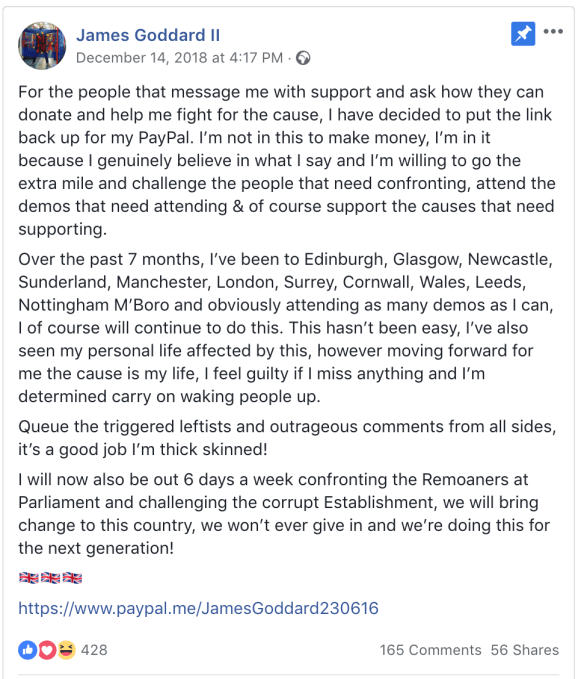
Earlier today one of his pages was still live on Facebook, and in a post from December 14 Goddard can be seen soliciting donations via PayPal so he can continue “confronting” people.

We also asked PayPal about Goddard’s use of its tools, pointing to the company’s terms of use which prohibit the use of the platform for promoting “hate, violence, racial and other forms of intolerance that is discriminatory”.

PayPal declined to comment on “any specific customer’s account”, citing its privacy policy but a spokesperson told us: “We do review accounts that have been flagged to us for possible breaches of our policies, and we will take action if appropriate.”

A few hours later PayPal also appeared to have pulled the plug on Goddard’s account.

A Patreon page he had seemingly been using to solicit donations for “political content, activism” is also now listed as ‘under review’ at the time of writing.

But Goddard remains on Twitter, where he is (currently) complaining about being de-platformed by Facebook and PayPal to his ~4k followers, and calling other people “fascists”.

How should mainstream tech platforms respond to people who use their tools for targeted harassment? If you read companies’ terms and conditions most prohibit abusive and intimidating conduct. Though in practice plenty flows until flagged and reviewed. (And even then takedowns frequently fail to follow.)

For all the claims from platforms that they’re getting better about enforcing their claimed community standards there are countless of examples of continued and very abject failure.

Facebook’s 2.2BN+ users especially make for an awful lot of content to wrangle. But none of these platforms is renowned for being proactive about weeding out violent types of speech they claim to forbid. And when intimidation is dressed up as political speech, and public figures are involved, they appear especially paralyzed.

Social media-savvy Far Right groups grokked this loophole long ago (see: Gamergate for a rough start date); and are continuing to exploit default inaction to get on with the violent business of megaphoning hate in the meanwhile.

You could say platforms are being gamed but the money they make off of accelerated outrage makes them rather more complicit in the problem.

The irony is it’s free speech that suffers in such a thuggish and febrile atmosphere. Yet platforms remain complicit in its undoing; doing nothing to stop hate mongers turning hugely powerful high tech soapboxes into abuse funnels.

They do this by choosing to allow groups with fascist ideologies to operate freely until enough reports are filed and/or high level political attention frowns down on particular individuals that they’ll step in and act.

Facebook’s community standards claim it aims to prevent “real-world harm”. But with such a narrow prescription it’s failing spectacularly to prevent deliberate, malicious and co-ordinated harassment campaigns that are designed to sew social division and upend constructive conversation, replacing the hard won social convention of robust political debate with mindless jeering and threats. This is not progress.

There’s nothing healthy for society or speech if mainstream platforms sit on their hands while abusive users bludgeon, bully and bend public debate into a peculiarly intolerant shape.

But we’re still waiting for the tech giants to have that revelation. And in the meanwhile they’re happy to let you watch a live streamed glimpse of mob rule.


from Facebook – TechCrunch https://tcrn.ch/2LYXkQL
via IFTTT

Zuckerberg’s 2019 challenge is to hold public talks on tech & society

Rather than just focus on Facebook’s problems like his 2018 challenge, this year Mark Zuckerberg wants to give transparency to his deliberations and invite the views of others. Today he announced his 2019 challenge will be “to host a series of public discussions about the future of technology in society — the opportunities, the challenges, the hopes, and the anxieties.” He plans to hold the talks with different leaders, experts, and community members in a variety of formats and venues, though they’ll all be publicly viewable from his Facebook and Instagram accounts or traditional media.

This isn’t the first time Zuckerberg has held a series of public talks. He ran community Q&A sessions in 2014 and 2015 to take questions directly from his users. The idea for Facebook Reactions for expressing emotions beyond “Likes” first emerged during those talks.

From his initial framing of the 2019 challenge, though, it already sounds like Zuckerberg sees more Facebook as the answer to many of the issues facing society. He asks “There are so many big questions about the world we want to live in and technology’s place in it. Do we want technology to keep giving more people a voice, or will traditional gatekeepers control what ideas can be expressed? Should we decentralize authority through encryption or other means to put more power in people’s hands? In a world where many physical communities are weakening, what role can the internet play in strengthening our social fabric?”

The implied answers there are “people should have a voice through Facebook”, “people should use Facebook’s encrypted chat app WhatsApp”, and “people should collaborate through Facebook Groups”. Hopefully the talks will also address how too much social media can impact polarization, self-image, and focus. And given Zuckerberg is prone to sticking to his talking points, the public would benefit from talks held by moderators who don’t give the CEO all the questions ahead of time.

Hearing Zuckerberg’s candid thoughts on the inherent trade-offs of “bringing the world closer together” or “making the world more open and connected” could help users determine whose interests he has at heart.

Zuckerberg’s past challenges have been:

2009 – Wear a neck tie every day

2010 – Learn Mandarin Chinese

2011 – Only eat animals he killed himself

2012 – Write code every day

2013 – Meet a new person who isn’t a Facebook employee every day

2014 – Write a thank-you note every day

2015 – Read a new book every two weeks

2016 – Build an artificial intelligence home assistant like Iron Man’s Jarvis

2017 – Visit all 50 states he hadn’t already to meet and talk to people

2018 – Fix Facebook’s problems


from Facebook – TechCrunch https://tcrn.ch/2FijBc3
via IFTTT

Monday, January 7, 2019

A look back at the Israeli cyber security industry in

2018 saw a spate of major cyber attacks including the hacks of British Airways, Facebook and Marriott. Despite growing emphasis on and awareness of cyber threats, large organizations continue experiencing massive data breaches. And as the world becomes increasingly connected (cars and medical devices, among others), attack vectors are evolving and exposures multiply.

The Israeli cybersecurity industry has long been recognized as a hotbed for innovative solutions, and 2018 to be yet another strong year. Early stage companies raised more money than ever before to tackle emerging security threats like protecting the proliferating number of internet-connected devices and enabling blockchain technologies to thrive in more secure environments.

Growing seed rounds chasing greenfield opportunities

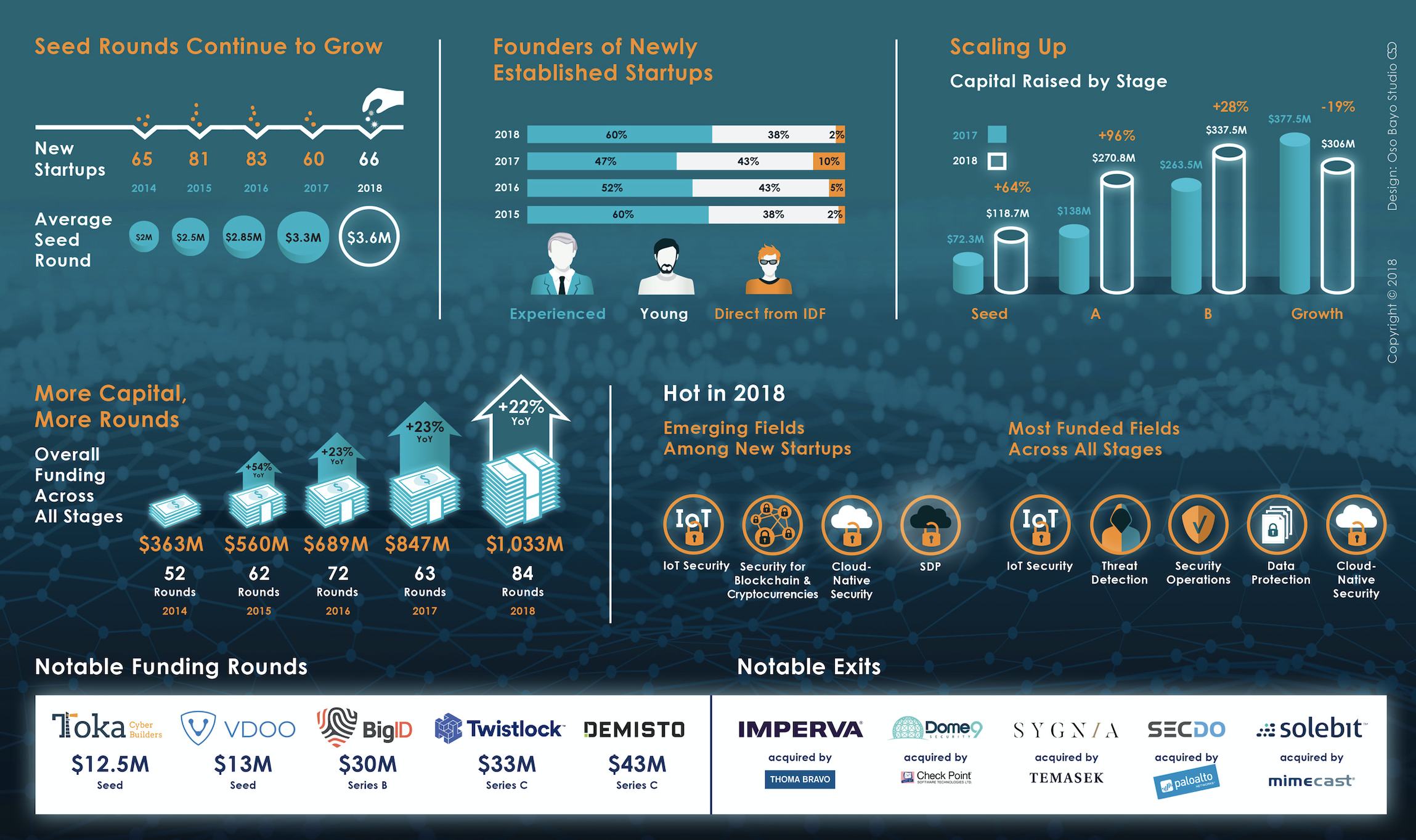
In 2018, the total amount of funding for Israeli cybersecurity companies across all stages grew 22 percent year-over-year to $1.03B. This closely matched the funding trends of 2016 and 2017 that each saw 23 percent year-over-year growth in funding amount. At the same time, 2018 saw 66 new companies founded, an increase of 10 percent over 2017, which represented a rebound after a dip last year (60 new companies in 2017 vs. 83 in 2016). Notably, average seed round increased to $3.6M in 2018 from $3.3M in 2017. 2018 marked the fifth consecutive year the size of Israeli cyber seed rounds grew. Since 2014, the average seed round size has increased 80 percent.

With industry growth metrics of Israeli cybersecurity up across the board in 2018, 2017’s dip in new cyber startups appears to have been an outlier. Not only does entrepreneurial interest in cyber look to be on the rise, investor enthusiasm, especially at the early stages, signals a market brimming with opportunity. Growing round sizes are interesting, but more revealing is following where this capital is flowing.

Emerging fields supplanting “traditional” technologies

The top emerging fields among new startups in 2018 included new verticals within IoT security, security for blockchain and cryptocurrencies, cloud-native security and SDP (Software Defined Perimeter). These nascent verticals drew considerably more attention than more “traditional” cyber sectors such as network security, email security and endpoint protection. Of all the emerging sectors, IoT drew the most investment with funding reaching $229.5M across all stages. What makes IoT particularly interesting is its continual branching into various new sub-domains including automotive, drones and medical devices.

Shai Morag, CEO and co-founder of Secdo, an Israeli cybersecurity firm acquired for $100M by Palo Alto Networks in mid-2018, sees these trends accelerating. “Innovation is going to keep happening in these areas for the next few years. We’ll also see innovation in third-party supply-chain risk assessment and management. Another wide-open field for innovation is SMBs. They are an underserved market hungry for full-stack solutions. These emerging fields are where I’m seeing the most excitement.”

Breaking out data on seed round funding into cyber startups targeting emerging vs. traditional markets reveals an even more pronounced growth trend. 2018’s aggressive early stage funding rounds disproportionately focused on companies pursuing emerging fields within cybersecurity. Of the 33 seed rounds raised in 2018, 20 (61 percent) went to companies in emerging fields. Even more striking, the sum of all seed rounds for emerging tech companies in 2018 was $79M, a 76 percent year-over-year increase. The numbers are clear, there is overwhelming investor interest in emerging cyber tech.

For example, the two largest seed funding rounds this year were in the IoT security domain. VDOO, founded by ex-Cyvera entrepreneurs (acquired by Palo Alto Networks in 2014 for $200M) and which develops security solutions for IoT vendors, raised an abnormally high seed round of $13M. Toka Cyber has secured $12.5M seed funding from Andreessen Horowitz and others, to develop and expand their IoT cybersecurity platform for governmental agencies. Twistlock, a pioneer developer of cloud-native security solutions raised $33M series C this year. BigID which protects sensitive data in light of GDPR and other privacy regulations raised both A ($14M) and B ($30M) rounds during 2018.

As the more traditional cybersecurity markets continue to consolidate and mature, prospects dim for “me too” cyber startups. We see that the industry still faces pressing problems in need of innovative solutions. Looming labor shortages, GDPR and other global data privacy legislation and the IoT explosion, are major challenges presenting substantial opportunities to incumbents able to provide relief. Investors and entrepreneurs sense greenfield opportunities on the horizon and are racing to plant their flags before the competition. This new divergent ecosystem is more selective of sophisticated, savvy investors and specialized, seasoned entrepreneurs.

Greenfields, not green founders

In 2018, 60 percent of founders had more than a decade’s worth of experience in the private sector–a 28 percent increase from 2017. The experience of these more seasoned founders came mostly from working in startups either as an executive or as an entrepreneur. Although Israel’s cybersecurity ecosystem relies heavily on the technical training potential entrepreneurs receive during service in the Israeli Defense Forces (IDF), in 2018, the proportion of founders coming straight out of the IDF fell to 2 percent, dropping from 10 percent the year before.

While nearly all Israeli founders leverage the skills and know-how acquired in the IDF’s various technological units, the need for experience from the private sector, either as an executive or an employee, seems to be more prevalent. Larger seed checks and larger ambitions are fuelling this push for more mature, veteran founders. Rising founders are not simply looking to build a novel technology and score a lucrative acquihire exit from an existing giant–they want to push into greenfield territory and stake a market-leading claim all their own.

Amichai Shulman, co-founder & former CTO of Imperva and a Venture Advisor at YL Ventures, gives such founders aiming to “own a market” the following advice: “Make sure you’re able to explain – primarily to yourselves – how your offering and product becomes something bigger than what it inherently is in the beginning. Be able to articulate how you expand (in the future) further into organizations, not just by ‘selling more’ but by solving bigger and more general problems.”

Cyber exits continue to overperform

Beyond general trends, 2018 also had many exciting individual exits. Checkpoint-Dome9 and CyberArk-Vaultive were notable because both acquirer and acquiree were Israeli — a mark of true market maturity. The acquisition of Sygnia by Singaporean holding giant Temasek also was remarkable because it shows that the Israeli cyber market continues to attract new classes and kinds of global strategic players each year. In addition, Thoma Bravo’s  $2.1B acquisition of Israeli cyber firm Imperva made waves throughout the industry.

Tsahy Shapsa, co-founder of Cloudlock, which was acquired by Cisco in 2016 for $293M, reflected on the potential he sees coming from growing global investment. “From an entrepreneurial perspective, there is a constant dilemma between short-/mid-term exits and building a legacy company. As funding floods into Israel from around the world, temptation to sell early only increases. But all these exits have an advantage. They grow the pool of experienced, ‘repeat’ entrepreneurs and set the stage for more legacy companies to originate locally.” Zohar Alon, CEO and co-founder of Dome9 Security, which was acquired by Checkpoint in 2018 for $175M added the following guidance: “Israeli entrepreneurs should establish and maintain a constant communication channel with the local corporate development leaders, same as most do with the VC community focusing on product and go-to-market synergies.”

Israeli cybersecurity maintaining momentum

In 2018, investors became more domain-focused and preferred emerging fields. With traditional cybersecurity consolidating, emerging greenfields signal much stronger potential. Furthermore, growth continued both in cybersecurity startups as well as their fundraising across all stages, indicating rising confidence in the Israeli cybersecurity market.

The 2018 Israeli cybersecurity market boasted an excellent exit climate, highlighted not only by Imperva’s large-scale acquisition but also by the diversity in the types of players in the space. As such, the local cybersecurity market signals its ability to create and nurture large-scale security vendors, thereby attracting variety of both international and local players which continue identifying and capitalizing opportunities in this domain. For 2018, as has been the case for many years past, the state of the cyber nation is strong–and 2019 appears to promise more of the same.


from Facebook – TechCrunch https://tcrn.ch/2VsQ9ot
via IFTTT

Thursday, January 3, 2019

Workplace, Facebook’s enterprise platform, adds another major customer, Nestle

While Facebook continues to repair its image with consumers disenchanted with the social network’s role in disseminating misleading or false information and mishandling their personal data, it’s ironically been finding some traction for its enterprise-focused service, Workplace. Today, the company announced that it has added another huge company to its books today: Nestle, the coffee, chocolate and FMCG giant with 2,000 brands and 240,000 employees, has signed up as its latest customer.

Facebook’s enterprise service competes against the likes of Microsoft Teams, Slack and smaller players like Crew and Zinc, among many others in a crowded market of mobile and desktop apps built to address a growing interest among organizations to have more user-friendly, modern ways for their employees to communicate.

Workplace positions itself as different from its competitors in a couple of different ways: it says its communications platform is designed for all different employment demographics, covering so-called knowledge workers (the traditional IT customer) as well as waged and front-line employees; but it also claims to be the most democratic of the pack, by virtue of being a Facebook product, designed for mass market use from the ground up.

In the workplace, that translates to apps that do not require company email addresses or company devices to use; a strong proportion of employees at Workplace’s bigger customers, such as Walmart (2.2 million employees) and Starbucks (nearly 240,000 employees) do not sit at desks and, until relatively recently, would not have been using any kind of PC or phone on a regular basis on any average day.

But as smartphones have become as ubiquitous as having your keys and wallet, acceptance of having them and utilising them to communicate workplace-related information has changed, and that is the wave that services like Workplace are hoping to ride.

But despite the strong engine that is Facebook behind it, Workplace has a lot of challenges up ahead.

The company has not updated its total number of customers in over a year at this point — its last milestone was 30,000 customers, back in November 2017 — and today Facebook VP Julien Codorniou said that the company might put out a more updated number later this year.

“We’re not using that metric to communicate our success,” he said, “but we have to communicate growth, I feel the demand from the market.” Slack claims 500,000 organizations, over 70,000 of which pay; Teams from Microsoft has some 329,000 customers, the company says.

There is also the issue of how a customer win is actually translating to usage. Last month, a much smaller competitor, Crew, with 25,000 customers, noted that at least some of them were in fact those that Workplace was claiming to have secured.

“Starbucks is theoretically using Workplace, but it’s been deployed only to managers,” Crew CEO Danny Leffel told me. “We have almost 1,000 Starbucks locations using Crew. We knew we had a huge presence there, and we were worried when Facebook won them, but we haven’t seen even a dent in our business so far.”

Codorniou said that this also doesn’t tell the full story. He describes the approach that Crew and others take as “shadow IT” in that the companies don’t talk to central HQ when winning the business. “You can’t give a voice to everyone by going in through the back,” he said. He also contends that it just takes time to deploy something across a massive business. “Workplace only works if you get 100 percent of the company using it,” he added. Notably, today Facebook announced that Nestle has already onboarded 210,000 customers to Workplace.

There is also the bigger question of how these products will develop technically to further differentiate from the pack. For now, it feels like Slack still reigns supreme when it comes to desktop knowledge worker functionality — even without usefully threaded comments — because of the fact that you can integrate virtually any other app you might want to into its platform.

Crew, meanwhile, has differentiated by focusing on providing handy tools to help businesses managing scheduling for shift workers, who comprise the majority of its user base.

While others like Teams, and yes, Workplace, have also added in integrations and their own functionality — Workplace’s most interesting features, I think, are how it has translated consumer-Facebook features like Live into the Workplace environment. But there is still a lot of space for apps to consider what other features and functionality will be most useful and stick for the most employees and for the business customer at large.

It will be interesting to see how and if this is affected by way of a key leadership appointment. Last month, Facebook appointed a new “head” of Workplace, Karandeep Anand, who came to Facebook three years ago from Microsoft (and thus has a close understanding of enterprise software). Codorniou said Anand be relocating to London, where Workplace is developed, and will focus on the technical development of the product while Codorniou focuses on sales, client relations and business development.

Technical leadership for Workplace had previously come straight from CTO Mike Schroepfer, Codorniou said. “We decided that we needed someone full time, here in London,” he said.

It’s not clear if Workplace’s win at Nestle is replacing another product: it seems, however, that it is more likely a trend of how more businesses are making an investment in company-wide communications platforms where they may never have had one before, in hopes of it helping keep employees switched on, linked up, and generally more happy and feeling less like expendable cogs.

“Nestlé is a people-first environment,” said EVP Chris Johnson, in a statement. “We really rely on our talented teams to manage more than 2,000 Nestlé brands worldwide. We help our employees develop and we give them the right tools, so Workplace is a perfect fit.”


from Facebook – TechCrunch https://tcrn.ch/2Vrg13V
via IFTTT

Tuesday, January 1, 2019

In 2018 the ticketing industry finally killed the ‘sold out’ show

Among the many myths that were laid low in 2018, perhaps none was as welcome to throngs of live event fans as the fantasy of the sold-out show. Indeed, as the ticket market has moved to adopt new technology the new-found transparency has had one prime victim: The Sellout.

The highest-profile debunking of the sellout in sports for 2018 came from Washington, DC.

Originally reported by the Washington Post, the Washington Redskins officially ended their decade-long season-ticket waitlist this June. Once claimed to be 200,000 fans deep, the reality of Redskins demand hadn’t been as rosy since the glory days of Riggins and Theisman. In 2018, the Redskins have been selling single game tickets like never before — even using the secondary market as a favorable point of comparison.

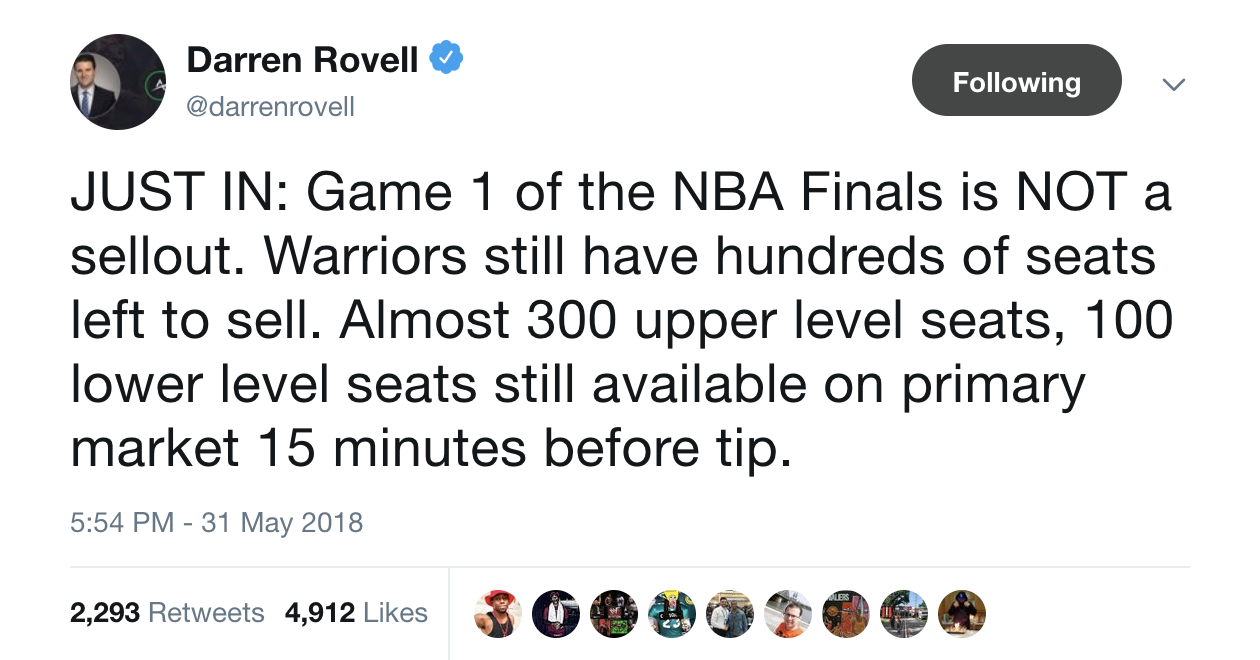
Other high-profile examples of this shift include the Golden State Warriors, who, despite selling out 100% of their regular season games, had hundreds of tickets available on for Game 1 of the NBA finals in the minutes before tip-off.

If the Redskins and Warriors signaled a shift away from the sellout era in sports, Taylor Swift’s Reputation tour did the same for music. Having wrapped up earlier this month, Reputation finished as the highest grossing US Tour in history, despite a flurry of articles lambasting the artist for not selling out many shows.  Ironically, it turns out that the most important factor in her record-breaking success was exactly that: not selling out.

Rather than a lack of demand, these unsold tickets for high-profile events are the result of the latest trend in the ticketing industry — making sure you have tickets to sell when fans want to buy them. Anyone that has purchased tickets on the Internet knows that the most active buying window is in the days and hours leading up to an event.

Before the Internet, while this last-minute market existed, it was contained to street corners and run by local brokers. For most of the 20th century, managing this aftermarket was a job ticket owners were comfortable outsourcing. With it’s limitless reach and real-time distribution, however, Internet-based selling changed their comfort level dramatically, by removing the ticket owner from the supply chain and costing them billions in margin. It also created a product category that became one of the worst, if not the worst, on the Internet.

If not for the universal appeal of live events, ticketing as a product would have died with Pets.com.  Instead, teams, artists and promoters became the poster children for the Internet’s power to disrupt. The response from many ticket owners was to simply to hang up a ‘Sold Out’ sign at the box office in the weeks, days and hours before the game — one that is just now starting to be taken down.

Photo courtesy of Getty Images

To understand why that happened, it’s important to recognize that when the Internet took off, teams were principally in the season-ticket business, while artists and promoters were in the record-selling business.  Selling last-minute, ‘on-demand’ tickets simply wasn’t a focus. The Internet, however, turned that secondary market niche into a product category worth $10 to $15 billion at it’s peak — two to three times the size of the primary market it was based on.

In order to compete in this always-on marketplace, ticketing technology has received billions of dollars of investment in the last decade, with the goal of making it more compatible with the Web itself. In the last two years, Ticketmaster, Seatgeek and Eventbrite have all announced ‘open platform’ models that make it as easy to sell tickets in places like Facebook and Youtube as it does in Stubhub.

In January, Ticketmaster and the NFL announced a new platform deal that, for the first time ever, allows teams and leagues to define their own distribution ecosystem.  As one of the biggest destinations for ticket buying online, sites like Stubhub and my company, TicketIQ, have become direct-to-fan distribution channels in the new ticketing marketplace.

(AP Photo/Jeff Chiu)

Before we singlehandedly credit technology for killing the sell out, it’s worth asking whether the decline in sellouts is simply the result of exorbitant ticket prices and increased competition for consumer attention. While there’s no question that it’s become harder to get people off of their couches for average events, the robust growth of the experience economy suggests the opposite trend.

According to a December 2017 McKinsey report, millennials spend 60% more on live experiences than GenXers — all in search of not only genuine connection, but also fresh social-media content. For the Reputation tour specifically, last-minute tickets on the secondary market were actually 35% cheaper than 1989 tour, which made buying tickets day-of the event more affordable than ever.

As for the Redskins, while their 2018 season hasn’t turned out as they’d hoped, at the box office, they’ve set themselves up for success in the years to come.  When demand spikes, whether as the result of a new stadium or a championship run, they’ll benefit directly and handsomely. As a point of reference for what kind of profit they might expect, the Financial Times reported that Taylor Swift’s per-show gross for Reputation increased by $1.4 million, including two dates in July at Fedex Field, home of the Redskins.

In “Look what you Made Me Do” the sixth song on the Reputation album, Taylor Swift sings about past “games”, “a tilted stage” and “unfair disadvantage”, for which she now seeks retribution. As a statement about her artistic and commercial stature, it’s clear she no longer wants to play nice. In addition to a jab at her artistic nemesis, Kanye West, it also reads like a farewell to the ticket market of old that has frustrated consumers for almost two decades.

Despite claims that she sold out her fans to achieve Reputation’s record-breaking success, the numbers mean that it’s a model we’ll be seeing much more of in the years to come. Regardless of how you feel about her forcing fans to Buy, Like and Watch to get their place in line for tickets, the good news for the ticket market overall is that it was her decision to make.


from Facebook – TechCrunch https://tcrn.ch/2F2kvt5
via IFTTT

Thursday, December 27, 2018

Google & Facebook fed ad dollars to child porn discovery apps

Google has scrambled to remove third-party apps that led users to child porn sharing groups on WhatsApp in the wake of TechCrunch’s report about the problem last week. We contacted Google with the name of one these apps and evidence that it and others offered links to WhatsApp groups for sharing child exploitation imagery. Following publication of our article, Google removed that app and at least five like it from the Google Play store. Several of these apps had over 100,000 downloads, and they’re still functional on devices that already downloaded them.

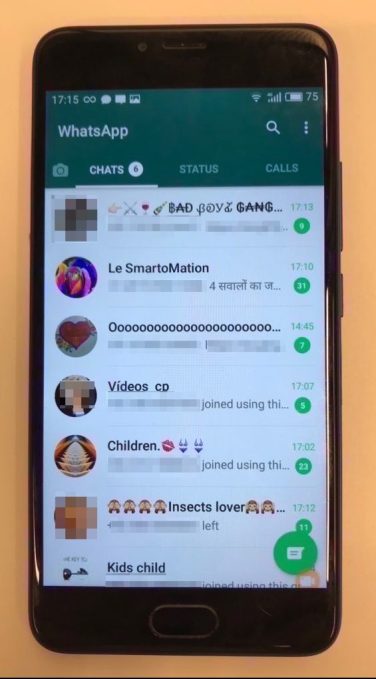
A screenshot from today of active child exploitation groups on WhatsApp. Phone numbers and photos redacted

WhatsApp failed to adequately police its platform, confirming to TechCrunch that it’s only moderated by its own 300 employees and not Facebook’s 20,000 dedicated security and moderation staffers. It’s clear that scalable and efficient artificial intelligence systems are not up to the task of protecting the 1.5 billion user WhatsApp community, and companies like Facebook must invest more in unscalable human investigators.

But now, new research provided exclusively to TechCrunch by anti-harassment algorithm startup AntiToxin shows that these removed apps that hosted links to child porn sharing rings on WhatsApp were supported with ads run by Google and Facebook’s ad networks. AntiToxin found 6 of these apps ran Google AdMob, 1 ran Google Firebase, 2 ran Facebook Audience Network, and 1 ran StartApp. These ad networks earned a cut of brands’ marketing spend while allowing the apps to monetize and sustain their operations by hosting ads for Amazon, Microsoft, Motorola, Sprint, Sprite, Western Union, Dyson, DJI, Gett, Yandex Music, Q Link Wireless, Tik Tok, and more.

The situation reveals that tech giants aren’t just failing to spot offensive content in their own apps, but also in third-party apps that host their ads and that earn them money. While these apps like “Group Links For Whats” by Lisa Studio let people discover benign links to WhatsApp groups for sharing legal content and discussing topics like business or sports, TechCrunch found they also hosted links with titles such as “child porn only no adv” and “child porn xvideos” that led to WhatsApp groups with names like “Children 💋👙👙” or “videos cp” — a known abbreviation for ‘child pornography’.

In a video provided by AntiToxin seen below, the app “Group Links For Whats by Lisa Studio” that ran Google AdMob is shown displaying an interstitial ad for Q Link Wireless before providing WhatsApp group search results for “child”. A group described as “Child nude FBI POLICE” is surfaced, and when the invite link is clicked, it opens within WhatsApp to a group called “Children 💋👙👙”.  (No illegal imagery is shown in this video or article. TechCrunch has omitted the end of the video that showed a URL for an illegal group and the phone numbers of its members.)

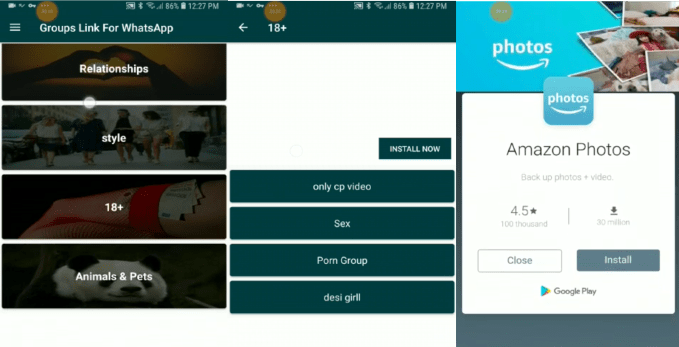
Another video shows the app “Group Link For whatsapp by Video Status Zone” that ran Google AdMob and Facebook Audience Network displaying a link to a WhatsApp group described as “only cp video”. When tapped, the app first surfaces an interstitial ad for Amazon Photos before revealing a button for opening the group within WhatsApp. These videos show how alarmingly easy it was for people to find illegal content sharing groups on WhatsApp, even without WhatsApp’s help.

Zero Tolerance Doesn’t Mean Zero Illegal Content

In response, a Google spokesperson tells me that these group discovery apps violated its content policies and it’s continuing to look for more like them to ban. When they’re identified and removed from Google Play, it also suspends their access to its ad networks. However, it refused to disclose how much money these apps earned and whether it would refund the advertisers. The company provided this statement:

“Google has a zero tolerance approach to child sexual abuse material and we’ve invested in technology, teams and partnerships with groups like the National Center for Missing and Exploited Children, to tackle this issue for more than two decades. If we identify an app promoting this kind of material that our systems haven’t already blocked, we report it to the relevant authorities and remove it from our platform. These policies apply to apps listed in the Play store as well as apps that use Google’s advertising services.”

App Developer Ad Network Estimated Installs   Last Day Ranked
Unlimited Whats Groups Without Limit Group links   Jack Rehan Google AdMob 200,000 12/18/2018
Unlimited Group Links for Whatsapp NirmalaAppzTech Google AdMob 127,000 12/18/2018
Group Invite For Whatsapp Villainsbrain Google Firebase 126,000 12/18/2018
Public Group for WhatsApp Bit-Build Google AdMob, Facebook Audience Network   86,000 12/18/2018
Group links for Whats – Find Friends for Whats Lisa Studio Google AdMob 54,000 12/19/2018
Unlimited Group Links for Whatsapp 2019 Natalie Pack Google AdMob 3,000 12/20/2018
Group Link For whatsapp Video Status Zone   Google AdMob, Facebook Audience Network 97,000 11/13/2018
Group Links For Whatsapp – Free Joining Developers.pk StartAppSDK 29,000 12/5/2018

Facebook meanwhile blamed Google Play, saying the apps’ eligibility for its Facebook Audience Network ads was tied to their availability on Google Play and that the apps were removed from FAN when booted from the Android app store. The company was more forthcoming, telling TechCrunch it will refund advertisers whose promotions appeared on these abhorrent apps. It’s also pulling Audience Network from all apps that let users discover WhatsApp Groups.

A Facebook spokesperson tells TechCrunch that “Audience Network monetization eligibility is closely tied to app store (in this case Google) review. We removed [Public Group for WhatsApp by Bit-Build] when Google did – it is not currently monetizing on Audience Network. Our policies are on our website and out of abundance of caution we’re ensuring Audience Network does not support any group invite link apps. This app earned very little revenue (less than $500), which we are refunding to all impacted advertisers.”

Facebook also provided this statement about WhatsApp’s stance on illegal imagery sharing groups and third-party apps for finding them:

“WhatsApp does not provide a search function for people or groups – nor does WhatsApp encourage publication of invite links to private groups. WhatsApp regularly engages with Google and Apple to enforce their terms of service on apps that attempt to encourage abuse on WhatsApp. Following the reports earlier this week, WhatsApp asked Google to remove all known group link sharing apps. When apps are removed from Google Play store, they are also removed from Audience Network.”

An app with links for discovering illegal WhatsApp Groups runs an ad for Amazon Photos

Israeli NGOs Netivei Reshet and Screen Savers worked with AntiToxin to provide a report published by TechCrunch about the wide extent of child exploitation imagery they found on WhatsApp. Facebook and WhatsApp are still waiting on the groups to work with Israeli police to provide their full research so WhatsApp can delete illegal groups they discovered and terminate user accounts that joined them.

AntiToxin develops technologies for protecting online networks harassment, bullying, shaming, predatory behavior and sexually explicit activity. It was co-founded by Zohar Levkovitz who sold Amobee to SingTel for $400M, and Ron Porat who was the CEO of ad-blocker Shine. [Disclosure: The company also employs Roi Carthy, who contributed to TechCrunch from 2007 to 2012.] “Online toxicity is at unprecedented levels, at unprecedented scale, with unprecedented risks for children, which is why completely new thinking has to be applied to technology solutions that help parents keep their children safe” Levkovitz tells me. The company is pushing Apple to remove WhatsApp from the App Store until the problems are fixed, citing how Apple temporarily suspended Tumblr due to child pornography.

Ad Networks Must Be Monitored

Encryption has proven an impediment to WhatsApp preventing the spread of child exploitation imagery. WhatsApp can’t see what is shared inside of group chats. Instead it has to rely on the few pieces of public and unencrypted data such as group names and profile photos plus their members’ profile photos, looking for suspicious names or illegal images. The company matches those images to a PhotoDNA database of known child exploitation photos to administer bans, and has human moderators investigate if seemingly illegal images aren’t already on file. It then reports its findings to law enforcement and the National Center For Missing And Exploited Children. Strong encryption is important for protecting privacy and political dissent, but also thwarts some detection of illegal content and thereby necessitates more manual moderation.

With just 300 total employees and only a subset working on security or content moderation, WhatsApp seems understaffed to manage such a large user base. It’s tried to depend on AI to safeguard its community. However, that technology can’t yet perform the nuanced investigations necessary to combat exploitation. WhatsApp runs semi-independently of Facebook, but could hire more moderators to investigate group discovery apps that lead to child pornography if Facebook allocated more resources to its acquisition.

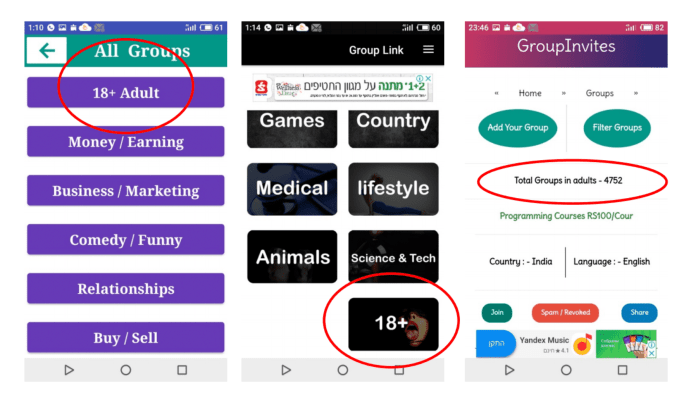
WhatsApp group discovery apps featured Adult sections that contained links to child exploitation imagery groups

Google and Facebook, with their vast headcounts and profit margins, are neglecting to properly police who hosts their ad networks. The companies have sought to earn extra revenue by powering ads on other apps, yet failed to assume the necessary responsibility to ensure those apps aren’t facilitating crimes. Stricter examinations of in-app content should be administered before an app is accepted to app stores or ad networks, and periodically once they’re running. And when automated systems can’t be deployed, as can be the case with policing third-party apps, human staffers should be assigned despite the cost.

It’s becoming increasingly clear that social networks and ad networks that profit off of other people’s content can’t be low-maintenance cash cows. Companies should invest ample money and labor into safeguarding any property they run or monetize even if it makes the opportunities less lucrative. The strip-mining of the internet without regard for consequences must end.


from Facebook – TechCrunch https://tcrn.ch/2T8FvB2
via IFTTT